Code
Dyads with children: 37 of 100 Dyads without children: 63 of 100 Replicating the children × partner WNC interaction
The headline result of Hahn, Binnewies, & Dormann (2014, Journal of Vocational Behavior) is that the presence of children in a household moderates the partner crossover effect of work–nonwork conflict on relationship satisfaction. Couples with children buffer the negative crossover; couples without children show the full negative effect.
This tutorial replicates that finding with the simulated dyad_data dataset, using both multilevel and SEM specifications. The DGP has a small but detectable interaction (int_child_pwnc = +0.10) — your likelihood ratio tests should recover it.
Dyads with children: 37 of 100 Dyads without children: 63 of 100 The baseline APIM (no moderation) is the same as the indistinguishable tutorial.
Linear mixed model fit by REML. t-tests use Satterthwaite's method [
lmerModLmerTest]
Formula: satisfaction ~ wnc + partner_wnc + recovery + partner_recovery +
    has_children + dual_earner + (1 | dyad_id)
   Data: ddl

REML criterion at convergence: 289.1

Scaled residuals:
     Min       1Q   Median       3Q      Max
-2.38505 -0.66160 -0.03835  0.58461  2.75274

Random effects:
 Groups   Name        Variance Std.Dev.
 dyad_id  (Intercept) 0.03146  0.1774
 Residual             0.19191  0.4381
Number of obs: 200, groups:  dyad_id, 100

Fixed effects:
                  Estimate Std. Error        df t value Pr(>|t|)
(Intercept)        4.82397    0.17008  95.00000  28.362  < 2e-16 ***
wnc               -0.25597    0.04024 176.98929  -6.362 1.65e-09 ***
partner_wnc       -0.17794    0.04024 176.98929  -4.422 1.70e-05 ***
recovery           0.22614    0.03862 191.89949   5.855 2.03e-08 ***
partner_recovery   0.12475    0.03862 191.89949   3.230 0.001456 **
has_children       0.02622    0.07957  95.00000   0.330 0.742436
dual_earner        0.30471    0.07959  95.00000   3.828 0.000231 ***
---
Signif. codes:  0 '***' 0.001 '**' 0.01 '*' 0.05 '.' 0.1 ' ' 1

Correlation of Fixed Effects:
            (Intr) wnc    prtnr_w recvry prtnr_r hs_chl
wnc         -0.171
partner_wnc -0.171 -0.316
recovery    -0.611  0.309 -0.070
prtnr_rcvry -0.611 -0.070  0.309  -0.091
has_childrn -0.069 -0.215 -0.215  -0.064 -0.064
dual_earner -0.212  0.067  0.067  -0.083 -0.083  -0.008
The moderated model adds the two interaction terms: partner WNC × children, and actor WNC × children.
Linear mixed model fit by REML. t-tests use Satterthwaite's method [
lmerModLmerTest]
Formula: satisfaction ~ wnc + partner_wnc + recovery + partner_recovery +
    has_children + dual_earner + partner_wnc:has_children + wnc:has_children +
    (1 | dyad_id)
   Data: ddl

REML criterion at convergence: 289

Scaled residuals:
     Min       1Q   Median       3Q      Max
-2.33706 -0.70526 -0.06712  0.58289  2.86573

Random effects:
 Groups   Name        Variance Std.Dev.
 dyad_id  (Intercept) 0.02402  0.1550
 Residual             0.19339  0.4398
Number of obs: 200, groups:  dyad_id, 100

Fixed effects:
                          Estimate Std. Error        df t value Pr(>|t|)
(Intercept)                4.78738    0.16619  94.00000  28.806  < 2e-16 ***
wnc                       -0.27451    0.04690 166.57401  -5.854 2.49e-08 ***
partner_wnc               -0.21804    0.04690 166.57401  -4.649 6.75e-06 ***
recovery                   0.23282    0.03835 189.09507   6.071 6.81e-09 ***
partner_recovery           0.13204    0.03835 189.09507   3.443 0.000707 ***
has_children              -0.06729    0.08598  94.00000  -0.783 0.435790
dual_earner                0.28394    0.07791  94.00000   3.644 0.000439 ***
partner_wnc:has_children   0.16125    0.08365 180.89618   1.928 0.055458 .
wnc:has_children           0.09502    0.08365 180.89618   1.136 0.257498
---
Signif. codes:  0 '***' 0.001 '**' 0.01 '*' 0.05 '.' 0.1 ' ' 1

Correlation of Fixed Effects:
            (Intr) wnc    prtnr_w recvry prtnr_r hs_chl dl_rnr prt_:_
wnc         -0.120
partner_wnc -0.120 -0.399
recovery    -0.603  0.237 -0.078
prtnr_rcvry -0.603 -0.078  0.237  -0.116
has_childrn -0.024 -0.053 -0.053  -0.088 -0.088
dual_earner -0.200  0.082  0.082  -0.089 -0.089   0.039
prtnr_wnc:_ -0.054  0.211 -0.516   0.032  0.057  -0.266 -0.065
wnc:hs_chld -0.054 -0.516 0.211 0.057 0.032 -0.266 -0.065 -0.252Data: ddl
Models:
model_base: satisfaction ~ wnc + partner_wnc + recovery + partner_recovery + has_children + dual_earner + (1 | dyad_id)
model_mod: satisfaction ~ wnc + partner_wnc + recovery + partner_recovery + has_children + dual_earner + partner_wnc:has_children + wnc:has_children + (1 | dyad_id)
npar AIC BIC logLik -2*log(L) Chisq Df Pr(>Chisq)
model_base 9 276.63 306.32 -129.32 258.63
model_mod 11 273.92 310.20 -125.96 251.92 6.719 2 0.03475 *
---
Signif. codes: 0 '***' 0.001 '**' 0.01 '*' 0.05 '.' 0.1 ' ' 1The p-value tests the joint null that both interaction terms (partner_wnc:has_children and wnc:has_children) are zero. In our DGP, only the partner-wnc interaction is non-zero (the actor-wnc interaction is zero), so the LRT is dominated by the partner-wnc effect.
The interactions package extracts the partner-WNC effect at each level of the moderator. With a binary moderator (has_children), this is a two-line output: the slope among dyads with children and the slope among dyads without children.
sim_pwnc <- sim_slopes(model_mod, pred = partner_wnc,
                       modx = has_children, johnson_neyman = FALSE)
print(sim_pwnc)
SIMPLE SLOPES ANALYSIS
Slope of partner_wnc when has_children = 0.00 (0):
Est. S.E. t val. p
------- ------ -------- ------
-0.22 0.05 -4.65 0.00
Slope of partner_wnc when has_children = 1.00 (1):
Est. S.E. t val. p
------- ------ -------- ------
-0.06 0.07 -0.79 0.43Among dyads without children, the partner-WNC slope is partner_wnc + 0 * partner_wnc:has_children ≈ -0.15. Among dyads with children, the slope is partner_wnc + 1 * partner_wnc:has_children ≈ -0.05. The negative partner crossover effect is attenuated (buffered) for couples with children — consistent with Hahn et al. (2014).
interact_plot(model_mod, pred = partner_wnc,
              modx = has_children, plot.points = TRUE)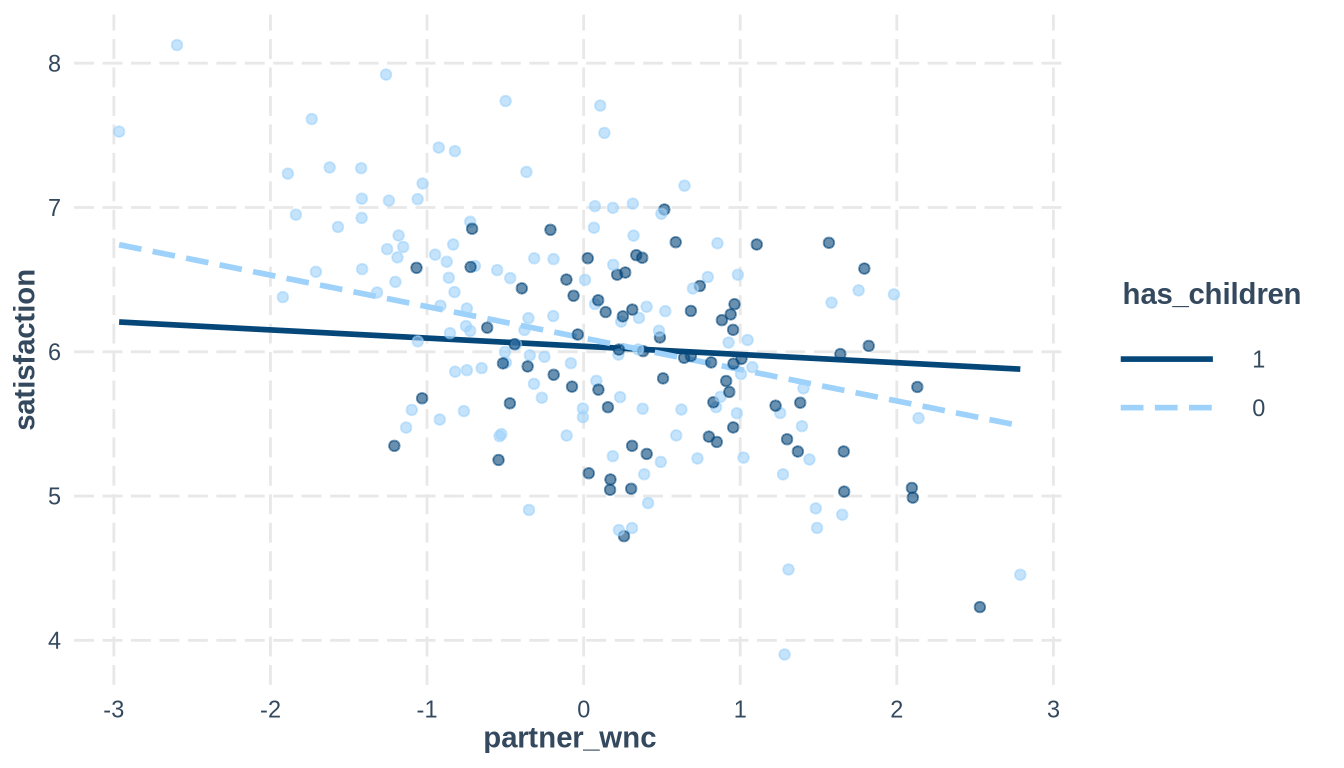
The SEM analogue creates manual product indicators in the wide data and fits a wide-format model with the products included.
ddw$wnc_a_children <- ddw$wnc_a * ddw$has_children
ddw$wnc_p_children <- ddw$wnc_p * ddw$has_childrenmodel_sem_mod <- '
# Actor (male) paths
satisfaction_a ~ a*wnc_a + p*wnc_p + ar*recovery_a + pr*recovery_p +
c*has_children + d*dual_earner +
a_int*wnc_a_children + p_int*wnc_p_children
# Partner (female) paths
satisfaction_p ~ a*wnc_p + p*wnc_a + ar*recovery_p + pr*recovery_a +
c*has_children + d*dual_earner +
a_int*wnc_p_children + p_int*wnc_a_children
# Intercepts (equal)
satisfaction_a ~ int*1
satisfaction_p ~ int*1
# Residual variances (equal)
satisfaction_a ~~ var*satisfaction_a
satisfaction_p ~~ var*satisfaction_p
# Predictor variances and covariances
wnc_a ~~ wnc_p
recovery_a ~~ recovery_p
# Residual covariance
satisfaction_a ~~ res_cov*satisfaction_p
# --------------------------------------------------------
# SIMPLE SLOPES (Calculated Parameters)
# --------------------------------------------------------
actor_slope_no_child := a + a_int * 0
actor_slope_has_child := a + a_int * 1
partner_slope_no_child := p + p_int * 0
partner_slope_has_child := p + p_int * 1
'
fit_sem_mod <- sem(model_sem_mod, data = ddw)
summary(fit_sem_mod, standardized = TRUE, fit.measures = TRUE)lavaan 0.6-21 ended normally after 30 iterations
Estimator ML
Optimization method NLMINB
Number of model parameters 31
Number of equality constraints 10
Number of observations 100
Model Test User Model:
Test statistic 133.699
Degrees of freedom 30
P-value (Chi-square) 0.000
Model Test Baseline Model:
Test statistic 359.107
Degrees of freedom 39
P-value 0.000
User Model versus Baseline Model:
Comparative Fit Index (CFI) 0.676
Tucker-Lewis Index (TLI) 0.579
Loglikelihood and Information Criteria:
Loglikelihood user model (H0) -654.118
Loglikelihood unrestricted model (H1) -587.268
Akaike (AIC) 1350.236
Bayesian (BIC) 1404.945
Sample-size adjusted Bayesian (SABIC) 1338.621
Root Mean Square Error of Approximation:
RMSEA 0.186
90 Percent confidence interval - lower 0.154
90 Percent confidence interval - upper 0.219
P-value H_0: RMSEA <= 0.050 0.000
P-value H_0: RMSEA >= 0.080 1.000
Standardized Root Mean Square Residual:
SRMR 0.193
Parameter Estimates:
Standard errors Standard
Information Expected
Information saturated (h1) model Structured
Regressions:
Estimate Std.Err z-value P(>|z|) Std.lv Std.all
satisfaction_a ~
wnc_a (a) -0.275 0.036 -7.535 0.000 -0.275 -0.403
wnc_p (p) -0.218 0.036 -5.985 0.000 -0.218 -0.295
recvry_ (ar) 0.233 0.035 6.576 0.000 0.233 0.296
rcvry_p (pr) 0.132 0.035 3.730 0.000 0.132 0.179
hs_chld (c) -0.067 0.082 -0.816 0.414 -0.067 -0.046
dul_rnr (d) 0.284 0.074 3.860 0.000 0.284 0.186
wnc__ch (a_nt) 0.095 0.069 1.383 0.167 0.095 0.084
wnc_p_c (p_nt) 0.161 0.069 2.347 0.019 0.161 0.102
satisfaction_p ~
wnc_p (a) -0.275 0.036 -7.535 0.000 -0.275 -0.371
wnc_a (p) -0.218 0.036 -5.985 0.000 -0.218 -0.320
rcvry_p (ar) 0.233 0.035 6.576 0.000 0.233 0.315
recvry_ (pr) 0.132 0.035 3.730 0.000 0.132 0.168
hs_chld (c) -0.067 0.082 -0.816 0.414 -0.067 -0.046
dul_rnr (d) 0.284 0.074 3.860 0.000 0.284 0.186
wnc_p_c (a_nt) 0.095 0.069 1.383 0.167 0.095 0.060
wnc__ch (p_nt) 0.161 0.069 2.347 0.019 0.161 0.142
Covariances:
Estimate Std.Err z-value P(>|z|) Std.lv Std.all
wnc_a ~~
wnc_p 0.516 0.110 4.682 0.000 0.516 0.530
recovery_a ~~
rcvry_p 0.218 0.087 2.502 0.012 0.218 0.258
.satisfaction_a ~~
.stsfct_ (rs_c) 0.020 0.021 0.945 0.345 0.020 0.095
Intercepts:
Estimate Std.Err z-value P(>|z|) Std.lv Std.all
.stsfctn_ (int) 4.787 0.159 30.093 0.000 4.787 6.834
.stsfctn_ (int) 4.787 0.159 30.093 0.000 4.787 6.827
wnc_a 0.247 0.103 2.397 0.017 0.247 0.240
wnc_p -0.033 0.095 -0.353 0.724 -0.033 -0.035
recovry_ 3.005 0.089 33.684 0.000 3.005 3.368
recvry_p 3.235 0.095 34.131 0.000 3.235 3.413
Variances:
Estimate Std.Err z-value P(>|z|) Std.lv Std.all
.stsfctn_ (var) 0.207 0.021 9.955 0.000 0.207 0.422
.stsfctn_ (var) 0.207 0.021 9.955 0.000 0.207 0.421
wnc_a 1.058 0.150 7.071 0.000 1.058 1.000
wnc_p 0.896 0.127 7.071 0.000 0.896 1.000
recovry_ 0.796 0.113 7.071 0.000 0.796 1.000
recvry_p 0.898 0.127 7.071 0.000 0.898 1.000
Defined Parameters:
Estimate Std.Err z-value P(>|z|) Std.lv Std.all
actr_slp_n_chl -0.275 0.036 -7.535 0.000 -0.275 -0.403
actr_slp_hs_ch -0.179 0.076 -2.363 0.018 -0.179 -0.319
prtnr_slp_n_ch -0.218 0.036 -5.985 0.000 -0.218 -0.295
prtnr_slp_hs_c -0.057 0.076 -0.747 0.455 -0.057 -0.192The MLM and SEM should agree on the interaction coefficients (p_int in SEM ≈ partner_wnc:has_children in MLM). The differences will be in the standard errors (Wald in SEM vs. profile in MLM).
# MLM partner-wnc × children
cat("MLM partner_wnc:has_children:\n")
MLM partner_wnc:has_children: estimate = 0.1613 # SEM p_int
pe <- parameterEstimates(fit_sem_mod)
sem_p_int <- pe[pe$label == "p_int", "est"]
cat("SEM p_int:\n")SEM p_int: estimate = 0.1613 0.1613 lme4, the moderation is a direct interaction term in the lmer formula. In lavaan, it is a manual product indicator in the wide-format data.